PRESS RELEASE
For his first solo exhibition in Ivory Coast, Moffat Takadiwa presents Rémanence, a series of works that grew out of a process of collecting materials between Harare and Abidjan, notably within the industrial zone of Yopougon. Wastelands, rubbish dumps, transformation workshops and logistical backyards serve as territories of exploration from which the artist retrieves plastics, technical components and manufactured fragments destined for abandonment. These peripheral sites – often absent from official urban narratives – become the starting point for a practice that examines the circulation of materials across the African continent and beyond.


-
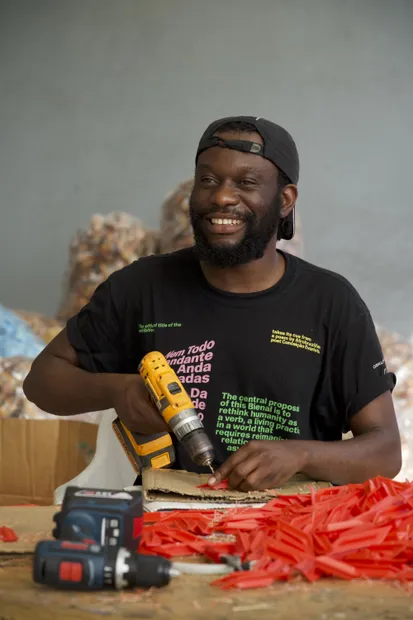
Born in 1983 in Karoi, in post-independence Zimbabwe, Takadiwa now lives and works in Mbare, on the outskirts of Harare. This district – widely recognised as one of the country’s principal centres for recovery and redistribution – has played a decisive role in shaping his artistic practice. Since the mid-2000s, Takadiwa has developed a distinctive sculptural language rooted in the collection, sorting and assemblage of manufactured residues. Computer keyboard keys, toothbrush heads, toothpaste tubes, plastic bottle caps and other synthetic fragments are transformed into vast, wall-based compositions of striking, almost organic density.The works presented in Rémanence extend this methodology while situating it within a new geographical and conceptual framework. By collecting materials at the intersection of two urban environments, the artist reveals a shared material continuity – that of a globalised economy whose excess circulates as widely as its commodities. Between the markets and depots of Mbare and the industrial zones of Yopougon, Takadiwa identifies a comparable landscape marked by accumulations of plastic, obsolete technological components and standardised packaging. Manufactured elsewhere, these objects arrive in African cities, where they enter informal systems of repair, resale or abandonment.It is at this critical juncture that the artist intervenes. After gathering substantial quantities of material, he meticulously sorts each element according to colour, form and texture. This disciplined process culminates in a sophisticated act of upcycling. Discarded objects are dismantled and reassembled, acquiring a value that surpasses their original function. Everyday fragments are perforated, bound and interwoven by hand, forming expansive modular surfaces. Through this deliberate and patient practice, accumulation is transformed into visual architecture.From a distance, these compositions evoke cartographic landscapes – irrigation networks, cultivated fields, urban grids or geological formations viewed from above. On closer inspection, the viewer gradually discerns the precise nature of the materials. This oscillation between abstraction and material specificity is central to Takadiwa’s work. The pieces initially captivate through their chromatic rhythms and repetitive structures, before revealing the ordinary origins of their constituent elements.The concept of remanence refers to what endures after an apparent disappearance—a trace, an imprint, a residual presence that continues to exert influence even after its source has faded. The materials employed by Takadiwa embody this notion. Plastics, keyboard keys and industrial remnants have already undergone multiple cycles of use before being discarded. While their original function has dissipated, they retain a latent material, social and ecological charge.In Takadiwa’s work, this persistence is made visible. Abandoned objects do not vanish; they accumulate, circulate and embed themselves within urban environments and informal economies. By assembling these fragments into monumental forms, the artist does not erase their histories but rather amplifies their continuity. Each component operates as an active vestige, underscoring the enduring impact of what contemporary societies discard.Within this framework, Takadiwa’s environmental engagement emerges not from abstract theory but from a direct and material intervention. By reclaiming fragments otherwise destined to pollute land and waterways, he symbolically redirects their trajectory. What once occupied the margins of the urban landscape is elevated to monumental presence; what appeared worthless is transformed into a luminous surface. Rather than proposing solutions to the ecological crisis, the artist invites a shift in perception – one that acknowledges the latent value embedded within discarded materials.The recurrent use of dismantled keyboard keys introduces an additional linguistic and political dimension. Removed from their original context, the letters no longer function as instruments of dominant language systems but instead become sculptural units in their own right. The fragmented alphabet forms a textured visual field, in which the tools of global communication are absorbed into a new, non-hierarchical syntax.Through Rémanence, Takadiwa presents an Africa shaped by global currents of production and consumption, yet capable of reconfiguring their symbolic meaning. The detritus of a globalised economy becomes the foundation for a renewed monumentality. Within his practice, sculpture operates as a process of transformation: residue becomes structure, the periphery assumes centrality, and abandonment is reimagined as formal power.
-

-
-
GALERIE FARAH FAKHRI
Moffat Takadiwa | Rémanence17 April–15 May 2026