Troy Makaza | Leave the Door Open


Makaza’s residency in Abidjan marks a decisive turning point in his artistic journey. He discovers a fast-paced, generous and vibrant city: a place where the light transforms without warning.“Abidjan is Abidjan,” he says, as though the word itself contained the full density of the place.
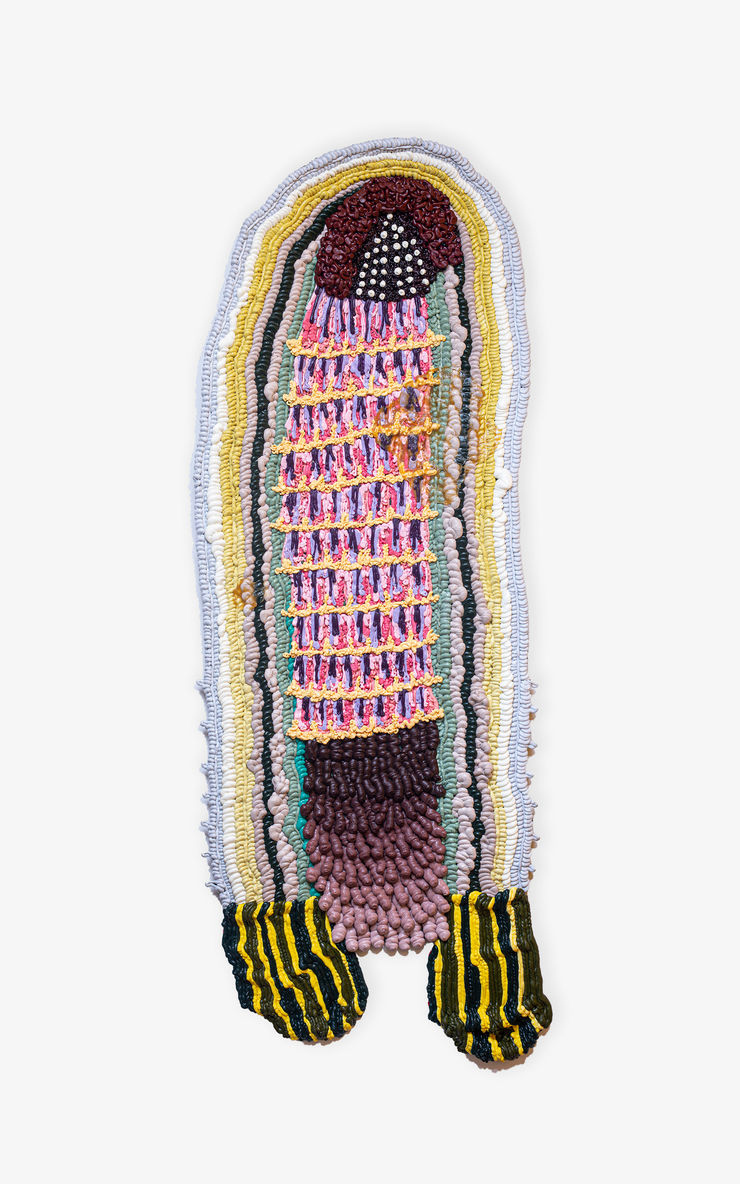
For almost a decade, Troy Makaza — a Zimbabwean artist acclaimed at the 60th Venice Biennale — has built a visual language that resists categorisation, standing proudly in that fluid zone where sculpture meets painting, where matter becomes narration. Born in 1994 in Harare, where he still lives and works, Makaza explores a singular medium with silicone at its core. This material, which he describes as “fresh, young and full of potential”, offers him an infinite field of experimentation. He approaches it like a living organism, able to retain the layers of his gesture, his hesitations, his accelerations and the sensitive archives of his view on the world.
Makaza’s residency in Abidjan marks a decisive turning point in his artistic journey. He discovers a fast-paced, generous and vibrant city: a place where the light transforms without warning. “Abidjan is Abidjan,” he says, as though the word itself contained the full density of the place. It is the night that particularly inspires him: its chromatic intensity, its ability to make colours throb like pulses. Immersed in this setting, Makaza adopts a different rhythm. The slower pace imposed by the climate and the shift in context opens up a new sense of time, a new way of seeing. The works born from this immersion in Côte d’Ivoire and exhibited in Leave the Door Open stand as witnesses to his encounters and experiences in the capital. They hum with his observations, resonating with his reflections on identity and belonging.
Through these works, Makaza continues to explore what it means to create from a rooted, local perspective while remaining in dialogue with a world in constant transformation. His practice does not aim to illustrate or proclaim; it reveals tensions, thresholds and points of passage. Silicone, colour and texture become vessels for a broader meditation on the ways in which personal, urban, spiritual or political stories engrave themselves into our bodies, our gestures and our journeys.
Everything begins in the quiet space of drawing. The sketch — always vibrant and colourful — is the place where form and intention first take shape. “I feel my work is ready when the sketch is right,” Makaza notes. This initial impulse may linger for years or assert itself at once. The final colours have already been determined. Once the silicone comes into play, there is no going back: it cannot be erased or reworked. This irreversibility gives rise to layered narratives — memories, emotions and observations crystallised in thick reliefs, taut or textured surfaces.
Makaza happily describes his ‘alphabet’ of textures. Every volume is a letter, every thickness an inflection. This tactile language evokes soil, skin, greenery, the shifting thresholds of an inner landscape. As these elements mingle, they compose a visual diary. “My works remind me of what I was thinking at the time, what I was going through, what I was experiencing.” The gesture becomes memory, and the memory takes shape.
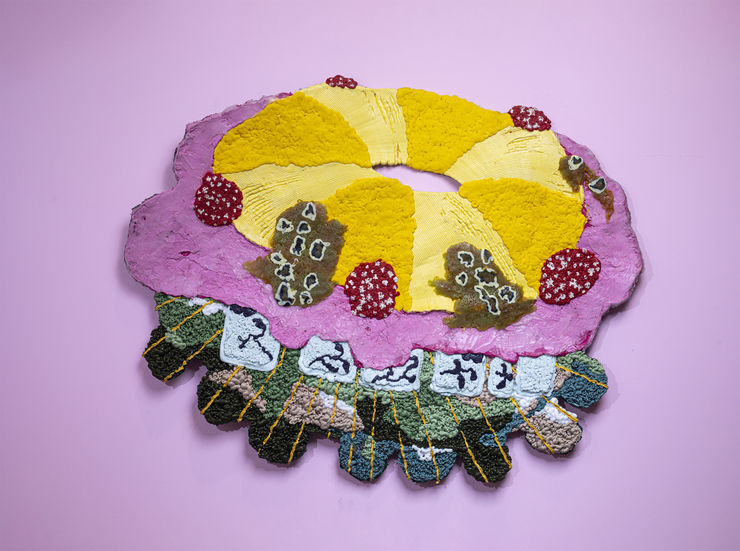
The Invisible Threshold, a pivotal work in the exhibition, translates the saturated green hues of the tropical vegetation the artist encountered in Banco National Park. It embodies the dense humidity charging the air — a technical challenge, as the material dries more quickly. Certain areas, flatter, reflect this climatic constraint. Others, with a rough softness, recall the skin of a bird, its living fragility. The title gestures towards what exists without showing itself, toward that sensory border dividing what can be explicitly perceived from what can only be intuited. The work appears as a passage, a threshold, a terrain in which the eye learns to navigate.
The artwork Leave the Door Open ventures into a more interior domain: that of spiritual presences, intimate stories and affective symbols from Zimbabwe. Seeds, fruits, petals and protective haloes weave a network of energies oscillating between gentleness and threat. The artist willingly introduces dissonant elements, breaking away from overly smooth harmony. He looks for a fertile tension, an unstable balance where beauty is crossed by unease, where the visible is troubled.
Makaza’s art never explains. It reveals. It opens spaces of perception through which we move between the intimate and the collective, between what can be clearly seen and what can only be glimpsed. His works, created from living material, give shape to a contemporary African experience defined not by opposition nor by continuity, but by the layering of realities, the coexistence of forces, the porosity of worlds.
Makaza at the threshold: the threshold of materials, of narratives, of experiences. It is there, in this vibrant interstice, that his work finds its full force, a force that does not seek to dominate, but to reveal the lines, visible or invisible, that guide us.
Farah Fakhri